
 Give
Give
 Prayer
 Call Us
 Know Jesus

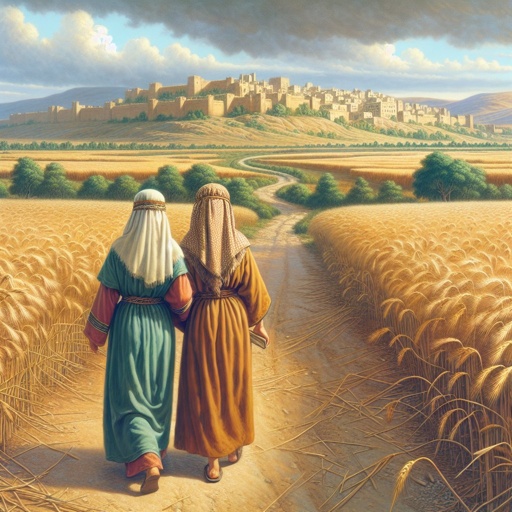
Ruth 1:3-5 Now Elimelek, Naomi’s husband, died, and she was left with her two sons. 4 They married Moabite women, one named Orpah and the other Ruth. After they had lived there about ten years,5 both Mahlon and Kilion also died, and Naomi was left without her two sons and her husband.
The Book of Ruth begins with the story of Elimelech, his wife Naomi, and their two sons Mahlon, and Chilion. They were from Bethlehem in Israel but had to flee from there because of a famine. They migrated east to the other side of the Dead Sea to the land of Moab – hoping things would get better. But it only got worse. Naomi’s husband died, and her two sons married two women: Orpah, and Ruth. Unfortunately for Naomi and the young brides, their husbands, Naomi’s sons died. If that wasn’t bleak enough a woman in the ancient Middle Eastern culture didn’t stand a chance physically, or financially without her immediate family. That is unless her extended family came to her rescue. Things were so bad for Naomi that she changed her name to Mara – or “bitter.” In Ruth 1:21 she makes an astounding statement: “I went out full, but the Lord has brought me home again empty.”
Elul is the season where we seek the Lord to refill our spiritual tanks. It is a time to return “home” but not to be bitter, or empty. It is a time to return to what we have been missing all along. Repeatedly I have taught that there is a sub-language buried beneath our translation of the Bible. Even deeper than the original languages of the Old Testament: Hebrew and Aramaic. One of those sub languages is what we would refer to as typology or symbology. Digging down to where the hidden meanings lie requires our taking a second look at where Naomi and her family were from. They were from Bethlehem in Israel. Bethlehem, as you know, means “House of Bread.” Israel derives its name from the Great Great Grandfather Jacob whose name was changed to Israel because he had wrestled with God through the “night” to know the Name of the Angel of the LORD. He prevailed in obtaining a blessing from this Heavenly Messenger (Can You Say, Jesus?) and his name (his walk, and character) was changed forever. Thus, it was no coincidence that the descendants of the one who wrestled with God and overcame – through the darkness – were experiencing famine in the land of the House of Bread. Sadly, the spiritual leader of the house, failed to wrestle with God for His Promise to provide “bread,” or “manna” for His children.
What’s even more telling is the following verse: “So she (Naomi) left the place where she was,….and they started on the way back to Judah.” Ruth 1:7
After losing her husband and two sons she leaves Moab (which interestingly enough means, Who’s your father?) and heads back back to Judah. To the way to Judah. Guess what Judah means? Praise, thanksgiving!
For those who are born again of the Spirit our home is in the Presence of our Lord and Master, Jesus. According to Psalms 22:3 God inhabits the praise of His people. The Hebrew word used in Psalm 22:3 for praise is “tehilla.“ Which is considered a song or hymn containing praise, and thanksgiving. The root of “tehilla” is the Hebrew word halal, where we get our word “halal-Jah!” Thus embedded in “tehilla” is a worship that is clamorously foolish, loud, and mad. It’s so loud it gets people’s attention! But guess what? Embedded in the Hebrew word “tehilla” is the idea of spontaneity, unrehearsed, Spirit-led praise, and thanksgiving.
Are you longing for home? Longing for Jesus? Experiencing a spiritual famine? Well the lesson from Naomi and Ruth is no matter how bad it gets we will find our way back Home to the place that Jesus inhabits – our spontaneous, unrehearsed, loud, attention getting, clamorously foolish, mad, Spirit-led – praise, worship, and thanksgiving. Oh and one more thing: when you think you’ve got it bad remember that Psalm 22 is a prophetic depiction of the crucifixion of Jesus. Where you gonna find the Bread of life to nourish you in your spiritual famine? On the cross. It’s from the cross, we worship and praise, the place He inhabits. We become a sacrifice of praise.